Situational Awareness And Safety
Situational Awareness for Safety and Survival
Situational awareness is often what determines whether you stay safe or put yourself at risk in a variety of situations. These range from everyday activities to survival events. It’s a concept where you train yourself to be aware in any given moment of what’s going on around you so that you can predict behavior and anticipate threats or dangers that you need to avoid.
Some of these are natural disaster situations or man-made events. This is a skill that you not only want to master yourself, but teach your family to adopt. Situational awareness is something many people have never cultivated, especially in a world where everyone walks around distracted by their phone, unaware of sounds because they have their earbuds on, or just lost in their own world.
An example of this would be a hiker lost on a trail in the woods. They have to stay aware of the terrain they’re standing on so they don’t fall off a cliff. They need to be aware of predators like bears or cougars. They also have to stay alert about weather and even other hikers.
This is something you need whether you’re in the wilderness alone or in the city with your entire family. Once you gain the skill, you’ll be thankful that you avoided precarious situations this far in life.
Fundamental Lessons of Situational Awareness
If you watch the news any given day, you’ll see moments in peoples’ lives when they failed to be aware of their surroundings. People in New York walking while on their phone and getting hit upside the head.
Hikers trotting along on a trail without any way to protect themselves and encountering a grizzly. Diners trying to enjoy a meal when a gunman bursts into a restaurant from behind them – the stories go on and on.
The basic thing you need to know about situational awareness is that you should always be in the mode of gathering information so you can process it. Everything may look perfectly normal, but if you study things carefully, you’ll be aware of small issues that may or may not be something you need to avoid.
Situational awareness comes in three stages, starting with perception. This is when you’re using your senses to see, hear, touch, smell and taste. Comprehension is next, and this is where you spot patterns or relationships between people, and your mind starts to put things together.
For phase three, you’re quickly playing out possible scenarios in your head and considering the risks you’re facing, making a plan to carry out. This is all done in an instant, not for hours at a time.
You can also use what’s known as the OODA Loop. This is where you observe your surroundings, orient yourself with a mental snapshot of the situation, decide what you’ll do and the act on your decisions.
The decision could be to move to a slightly different area of a room that allows for a quick escape, or retreating to somewhere else entirely until the threat (whether it’s a human, tornado, or something else) passes.
Practice Scenarios for Situational Awareness
You never want to be caught off guard and having to learn how to be situationally aware in an event that you have never been in before. It’s hard for you to practice things like disaster scenarios if they’re not happening, but you can pretend and make plans on how you would react if you are caught in a disaster scenario such as a wildfire, shooting scenario, or other threat.
You want to make sure that you are practicing in different locations, for different types of threats, and even based on encountering different types of weather or obstacles like terrain that could cause you to make a split second decision based on what you are observing and analyzing.
You might want to make a plan for situational awareness in your suburban or urban location. You need to know what kind of vulnerabilities are around you and what the community is like so that you can navigate events and deter unsavory behavior.
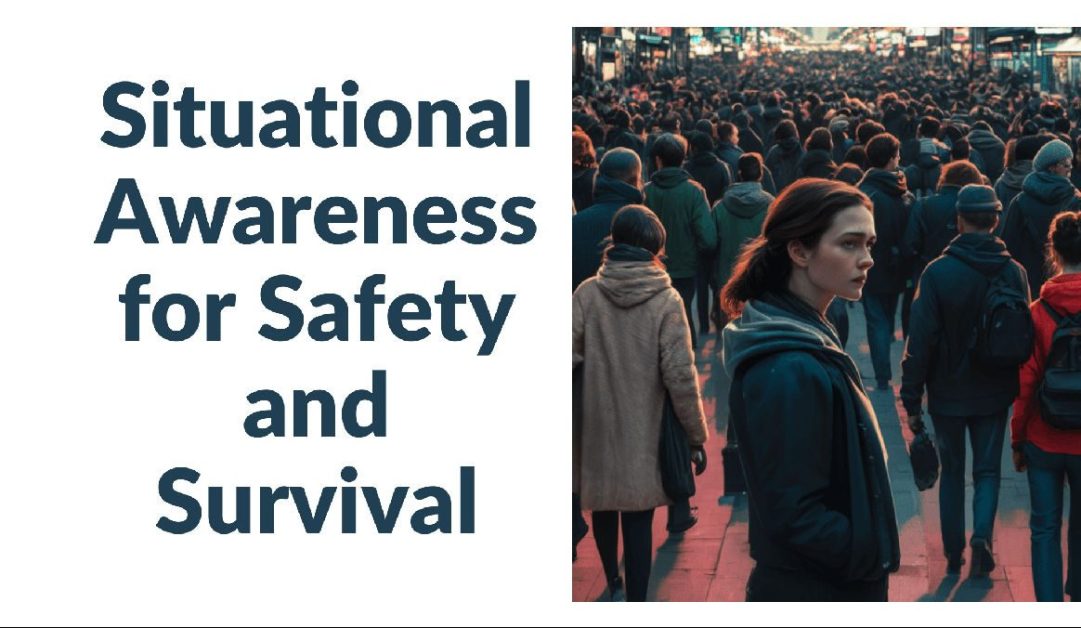
Practice being immersed in different levels of crowds, whether it’s sparse or fully packed locations. Navigate different structures to see how easy it is for you to take an escape route quickly and easily.
You also want to practice situational awareness in the wilderness in case you have to bug out. You never want to be complacent just because you have escaped a city environment and assume you are alone in a remote location.
It’s important that you practice not only situational awareness as an individual, but also as a group, because one person making a mistake could have dire consequences for everyone.
In a wilderness environment, you’ll want to be situationally aware about any natural hazards, the weather, wildlife, and even humans that you may encounter that could be hostile to your own group.
Don’t forget that in times like this, you might be facing other threats that are self-imposed. You have to be aware of your own physical and emotional state so that you can recognize when your judgment is beginning to be impaired, which might require sleep, food, water, or some sort of self soothing.


