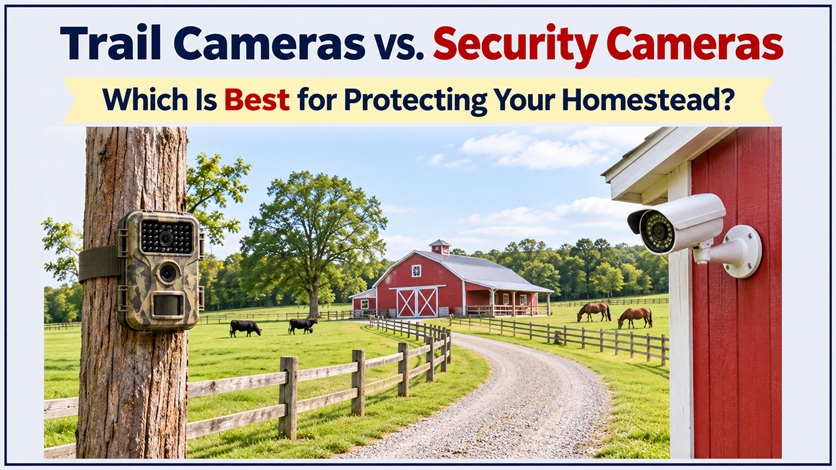
Trail Cameras vs. Security Cameras: Which Is Best for Protecting Your Homestead?
A Practical Guide to Choosing the Right Cameras for Your Rural Property
One of the greatest pleasures of country living is having plenty of room to spread out. There’s space for a garden, a few animals, maybe a workshop or barn, and enough privacy to enjoy the outdoors without neighbors right next door.
But all that wonderful space comes with a challenge. How do you keep an eye on everything happening around your property?
Maybe your barn sits several hundred feet from the house, your driveway disappears behind a row of trees, or a pasture gate is completely out of sight. You can’t spend your entire day checking every building and listening for unfamiliar vehicles.
That’s where trail cameras and security cameras can make life a little easier.
Both can help protect your homestead, but they work differently. Choosing the right one depends on what you want to monitor, how far the location is from your house, and whether electricity or internet service is available.
Let’s look at the differences so you can make a smart decision without spending more money than necessary.
1. Trail Cameras: A Practical Choice for Remote Areas
Trail cameras were originally designed for hunters and wildlife enthusiasts who wanted to see what wandered through the woods.
Today, they’re also useful for monitoring rural property.
Most trail cameras operate on batteries and automatically capture photographs or short videos when their sensors detect movement. They can be mounted on trees, fence posts, or other suitable locations.
One of their biggest advantages is that many trail cameras work without Wi-Fi or electricity.
That makes them especially convenient for monitoring:
- Remote pasture gates
- Wooded trails and access roads
- Equipment sheds
- Livestock areas
- Long country driveways
- Isolated sections of property
Basic trail cameras store images on a memory card. You’ll need to visit the camera occasionally to see what’s been recorded, but that may be perfectly acceptable for areas you don’t need to monitor constantly.
Cellular trail cameras offer additional convenience. These models can send photographs and alerts to your smartphone using a cellular network, provided adequate coverage and an active data plan are available.
For a distant gate or wooded section of your property, a trail camera may be exactly what you need.
2. Security Cameras: Better for Homes and Buildings
Security cameras are generally designed for monitoring homes, garages, workshops, and other frequently used areas.
Many connect to your home’s Wi-Fi network and let you check live video from a smartphone. Some even allow two-way conversations, which can be convenient when delivery drivers or unexpected visitors arrive.
Depending on the model, security cameras may provide:
- Live video viewing
- Motion alerts sent to your phone
- Two-way audio communication
- Infrared or color night vision
- Continuous or motion-activated recording
- Local or cloud video storage
These features make security cameras particularly useful around entrances and buildings containing valuable belongings.
However, there’s an important consideration for rural homeowners.
A camera is only as useful as its connection allows it to be.
A Wi-Fi camera installed near your front porch may work beautifully. Move that same camera to a barn several hundred feet away, and the signal could become unreliable.
Some security cameras use wired connections or cellular service instead, while certain models can record locally without internet access.
Before purchasing, make sure the camera’s connectivity requirements match the location where you’ll install it.
3. What If Your Property Doesn’t Have Reliable Wi-Fi?
Anyone who lives in the country knows that internet coverage can be unpredictable.
You might have a strong Wi-Fi signal inside your home but lose the connection halfway down the driveway. Beyond the barn or out in the pasture, there may be no signal at all.
Fortunately, that doesn’t mean those areas can’t be monitored.
A traditional trail camera can record activity directly to a memory card without an internet connection. A cellular trail camera can send images remotely, although it requires mobile network coverage.
Battery-powered and solar-compatible security cameras are also available, including models designed to operate over cellular networks.
Just remember that solar power provides electricity, not an internet connection.
Before purchasing any cellular camera, check the signal at the exact installation location. Coverage near your house doesn’t guarantee reliable service behind a distant barn or wooded hillside.
4. Which Camera Works Best for Driveways, Barns, and Pastures?
The best choice often depends on what you’re trying to protect.
For long driveways, a security camera can be useful when Wi-Fi reaches the entrance. If the driveway is too far away, a trail camera or cellular camera may be more practical.
Consider pairing the camera with a driveway alarm. The alarm alerts you when movement or a vehicle is detected, while the camera helps show what caused the alert.
For barns and workshops, security cameras are often convenient when electricity and a dependable connection are available. They let you monitor entrances and receive notifications about activity around stored tools, machinery, and equipment.
For remote pasture gates and wooded trails, battery-powered trail cameras are frequently the easier choice. They require little infrastructure and can operate in locations where traditional security cameras might be difficult to install.
A combination of camera types may provide better coverage than trying to use the same model everywhere.
5. Don’t Overlook Solar Power and Night Vision
Two features deserve special attention when choosing cameras for rural property.
Solar-Powered Cameras
Solar-compatible cameras can be useful for gates, barns, and remote locations without electrical outlets.
A solar panel helps recharge the camera’s battery, potentially reducing the need for frequent battery changes.
However, solar panels need adequate sunlight. Cameras installed beneath heavy tree cover may struggle to recharge, especially during cloudy winter weather.
Before buying, make sure the camera and solar panel are compatible and that the installation location receives enough sunlight.
Night Vision
Country properties can become extremely dark after sunset, making nighttime recording particularly important.
Many trail cameras use infrared illumination to photograph activity in darkness. Some offer no-glow infrared lighting that produces little or no visible light.
Security cameras may use infrared night vision or built-in spotlights that help capture color images after dark.
When comparing cameras, look for actual nighttime photographs or video samples rather than relying entirely on advertised detection distances.
A camera might detect movement at a considerable distance without capturing enough detail to identify a person or vehicle.
6. Compare the Costs Before Buying
It’s surprisingly easy to spend more than necessary on camera equipment.
A basic trail camera may be perfectly adequate for checking a remote pasture gate once a week. There’s little reason to pay for cellular service if you don’t need immediate notifications.
On the other hand, spending more for live viewing and dependable alerts may make sense when monitoring your main driveway or an expensive equipment shed.
Before buying, consider these possible expenses:
- Cellular data plans
- Cloud storage subscriptions
- Replacement batteries
- Memory cards
- Solar panels
- Mounting hardware
Those costs can add up when installing cameras across several acres.
A sensible approach is to start with one or two important locations and expand only when necessary.
This gives you an opportunity to test the equipment before investing in additional cameras.
7. A Simple Camera Buying Checklist
Before making your final decision, ask yourself a few practical questions.
- Power: Will the camera need an outlet, batteries, or a solar panel?
- Connectivity: Does the location have dependable Wi-Fi or cellular service?
- Weather resistance: Can it handle rain, dust, snow, and temperature changes?
- Night vision: Will it capture useful images after dark?
- Battery life: How frequently will batteries need changing or recharging?
- Motion detection: Can sensitivity be adjusted to reduce unnecessary recordings?
- Storage: Will footage be saved locally, online, or both?
- Notifications: Do you need immediate phone alerts?
- Monthly fees: Are subscriptions required for the features you want?
- Installation: Can you mount and maintain the camera easily?
Answering these questions before shopping can prevent unnecessary expenses and frustration.
Remember, the most expensive camera isn’t necessarily the best choice. What matters is choosing equipment that works reliably where you need it.
8. Sometimes the Best Solution Is Both
There’s no rule saying every camera around your homestead must be the same type.
A security camera might monitor the front porch, while another watches the workshop. A trail camera could cover the back pasture gate, and a cellular model might monitor a remote access road.
This combination allows you to choose the right equipment for each location without paying for features you don’t need.
Of course, cameras should be just one part of your security plan.
Sturdy gates, dependable locks, outdoor lighting, and trustworthy neighbors are equally important. And don’t forget the family dog! Sometimes an alert pet notices an approaching visitor before any electronic device sends a notification.
Final Thoughts: Keep Your Homestead Security Simple
Protecting your rural property doesn’t have to involve expensive equipment or a complicated security system.
Trail cameras are especially practical for remote areas without electricity or Wi-Fi. Security cameras are often better suited for homes, workshops, and entrances where live viewing and quick notifications are useful.
For many country homeowners, combining both provides a practical and affordable solution.
Start by identifying the locations that need attention most. Choose cameras that match the available power and connectivity, then add more equipment only when there’s a good reason.
After all, country living should be about enjoying your property, not constantly worrying about what’s happening around it.
A few well-placed cameras can help protect your home, land, animals, and equipment while giving you more time to enjoy the peace and quiet that makes rural living so special.